


Stakeholders in the Ethiopian seed sector recently convened to discuss the seed production and marketing plan. This important gathering brought together key players in the industry to strategize and collaborate on ways to enhance seed production and improve the marketing of seeds in Ethiopia. The forum was organized by the Ministry of Agriculture in collaboration with the Ethiopia Netherlands Seed Partnership in Adama on November 11, 2023. The main objective of the forum was to evaluate the achievements of the previous year and discuss a three-year seed production and marketing plan for major crops.
The three-year seed production and marketing plan for major crops, covering all seed classes, was presented for discussion. The plan aims to produce 2.31 million quintals of certified seed by the end of the third year, with 1.52 million quintals already produced in 2021. Participants agreed that the target was achievable.
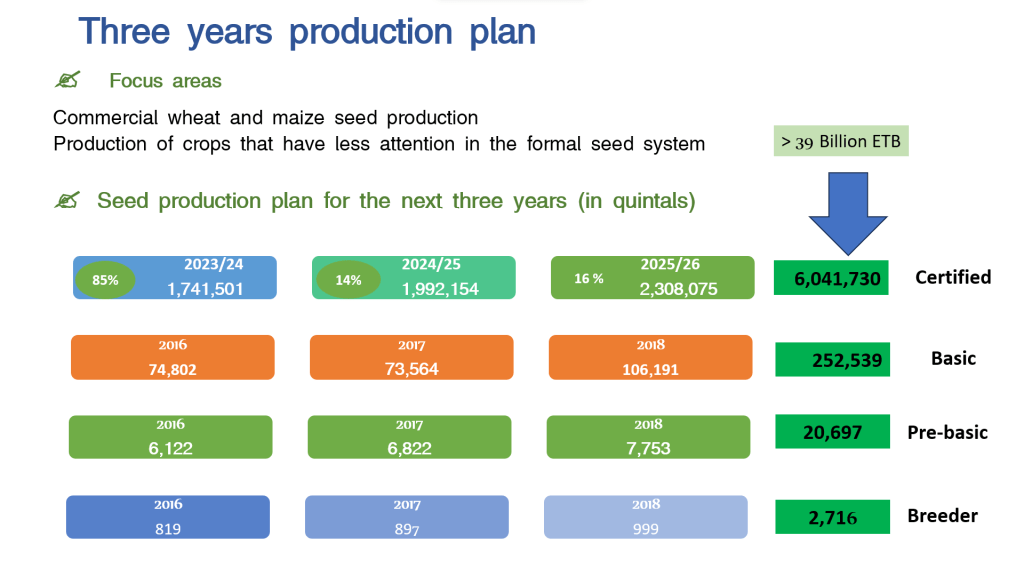
The plan also includes a potato seed supply component, which is uncommon in Ethiopia’s seed supply planning. The goal is to produce and supply 238,929 quintals of potato seed tubers by the end of the third year.
In addition to the numerical figures, the presentation also addressed the various challenges that could impede the attainment of the targets and proposed strategies to overcome these obstacles. A significant portion of the discussion revolved around enhancing coordination among the stakeholders to effectively achieve the desired outcomes. A preliminary coordination structure was presented, which included technical committees at both federal and regional levels as well as a steering committee at the federal level. It is crucial to note that the minister expressed his unwavering commitment to leading the steering committee. The minister emphasized that the technical committees would be responsible for outlining specific activities and assigning roles to different actors, while also ensuring that there is no duplication or overlap in efforts to attain the planned targets. Furthermore, the technical committees are tasked with proposing improved approaches for implementation and monitoring, evaluation, and learning (ME&L). The minister emphasized that by building upon existing knowledge and embracing innovative methodologies, we can establish a robust system that effectively meets the needs of farmers.
At the end of the forum, the next steps were discussed in smaller teams. It was decided that the governance structure would be refined based on the suggestions put forth by these teams and subsequently presented to the minister for approval. The technical committees, including those situated in various regions, will be convened in a kick-off meeting to ensure a level playing field for all parties involved.
In conclusion, the national consultative seed forum was a significant step towards achieving the goal of producing and supplying certified seeds for major crops in Ethiopia. With better coordination, commitment from stakeholders, and a functioning governance structure, it is possible to establish a strong system that responds to the demand of farmers. ENSP is committed to support the efforts of the ministry to establish a functioning seed system
The forum was attended by major stakeholders in the Ethiopian seed sector from both regional states and federal levels. The forum was well-received by participants who were pleased to see such an event taking place, as there had been no similar gatherings in recent years.

You must be logged in to post a comment.