


As Ethiopia strengthens its variety release and registration system, regional experience offers practical lessons for building testing services that are transparent, standardized, reliable, sustainable and affordable. Getting the model right matters to regulators, breeders and seed companies and ultimately to farmers who depend on well-performing varieties.
Variety testing provides the evidence needed to confirm that a candidate variety meets required standards and offers clear merit before it reaches farmers. Distinctness, Uniformity and Stability (DUS) examination underpins Plant Variety Protection (PVP), while Value for Cultivation and Use (VCU); also conducted as a National Performance Trial (NPT); assesses agronomic performance, adaptation and value under relevant agro-ecological conditions.
Why DUS matters beyond variety release
DUS examination is essential not only for variety release and registration, but also for an effective PVP system. It establishes whether a candidate variety is distinct, uniform and stable. An affordable, technically robust DUS service can therefore support breeding investment, innovation and greater private-sector participation.
Regional fee levels provide a useful benchmark for Ethiopia. The aim should be to recover the reasonable cost of a technically sound service without setting fees so high that breeders and seed companies are discouraged from introducing new varieties or that Ethiopia’s prospects for earning foreign currency through seed and planting-material exports are constrained.
What regional experience shows
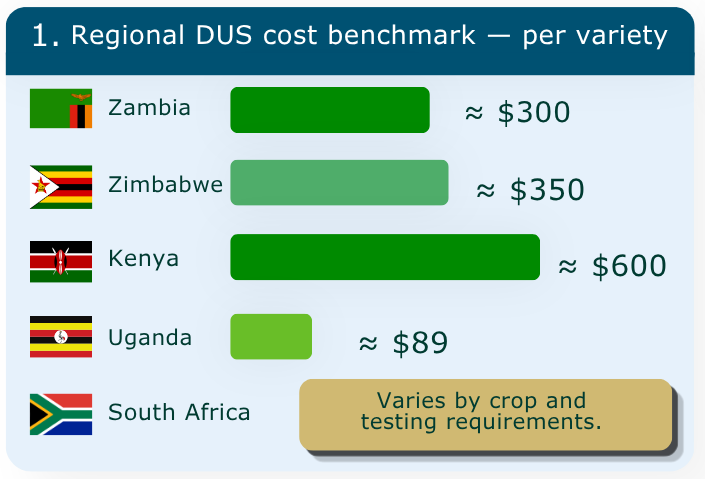
The 2026 TASAI Zambia report highlights DUS and VCU/NPT costs across African countries. DUS fees The 2026 TASAI Zambia report provides a comparative analysis of DUS and VCU/NPT costs across African nations. For DUS, the costs range between $300 and $600, with variations depending on the crop in South Africa.
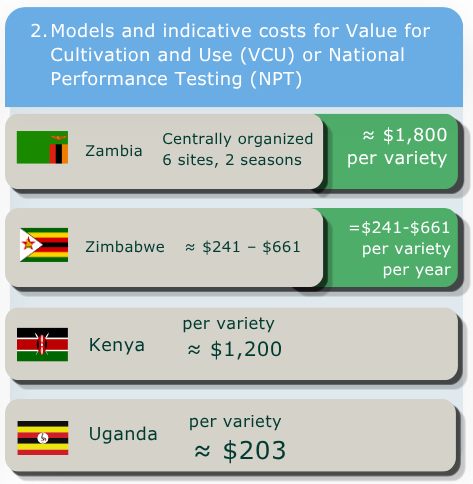
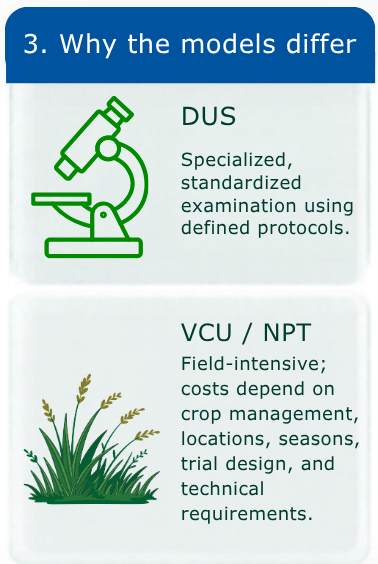
Similarly, VCU/NPT expenses range from $203 to $1,800. These disparities underscore the diverse models and costs involved. Ethiopia can leverage these insights to create more effective systems, thereby enhancing investments in the seed sector.
Ethiopia’s current testing landscape
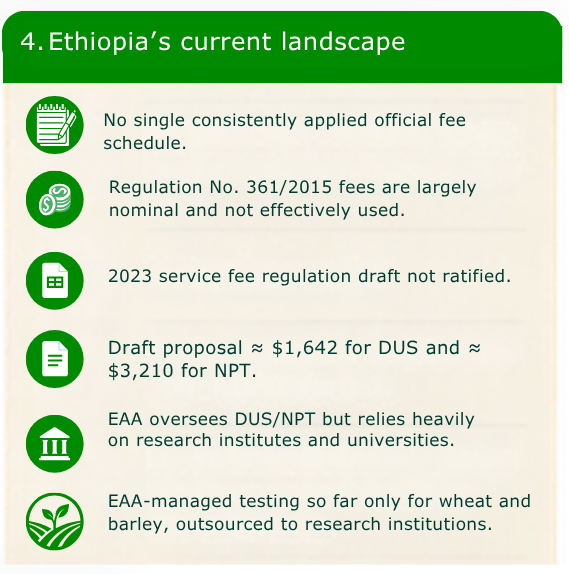
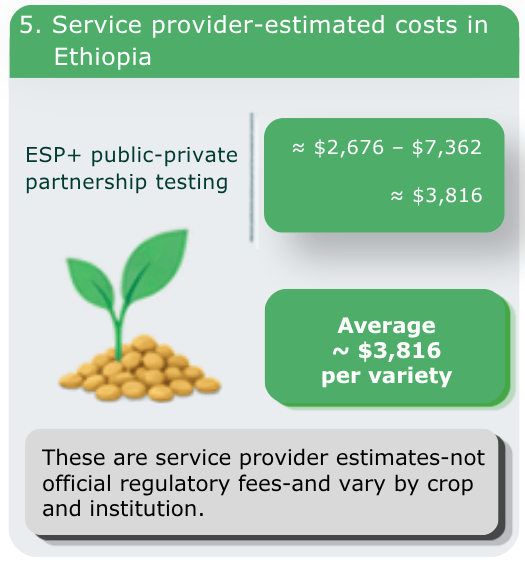
Ethiopia lacks a consistent fee schedule for variety testing, as the previous regulation from 2015 is outdated and a 2023 draft is yet to be ratified. The Ethiopian Agricultural Authority oversees these tests but relies on research institutes due to limited resources, managing only wheat and barley tests so far. In the absence of official fees, providers estimate costs, which vary based on several factors. This variability highlights the need for a standardized fee structure.
Regional harmonization could reduce duplication
Ethiopia, Zambia, Zimbabwe and Kenya are members of COMESA, which operates a regional variety-registration system for crops including potato, cereals, legumes, roots and tubers, and cotton. For eligible crops, regional registration can reduce duplicated testing and provide an alternative route to registration across participating countries, subject to regional and national requirements. Ethiopia already uses this pathway. However, when domestic registration costs are substantially higher than those in neighboring countries, companies may choose to register in two other COMESA countries and then market seed in Ethiopia.
Building a sustainable Ethiopian service model
Regional experience points to four priorities for the government and the EAA as they shape Ethiopia’s DUS and VCU/NPT service model:
- Establish clear, transparent and consistently applied service fees
- Accredit competent public and private providers for DUS and NPT services.
- Use regional experience and crop-specific requirements to inform fee setting.
- Strengthen the EAA’s DUS-testing capacity to support both variety release and PVP implementation.
Above all, approving and implementing the service-fee regulation and fully applying the variety-testing and registration framework would give Ethiopia a more predictable system. A transparent model that distinguishes the technical and cost requirements of DUS from those of VCU/NPT could protect regulatory quality while making Ethiopia more attractive to breeders and seed companies.

You must be logged in to post a comment.