
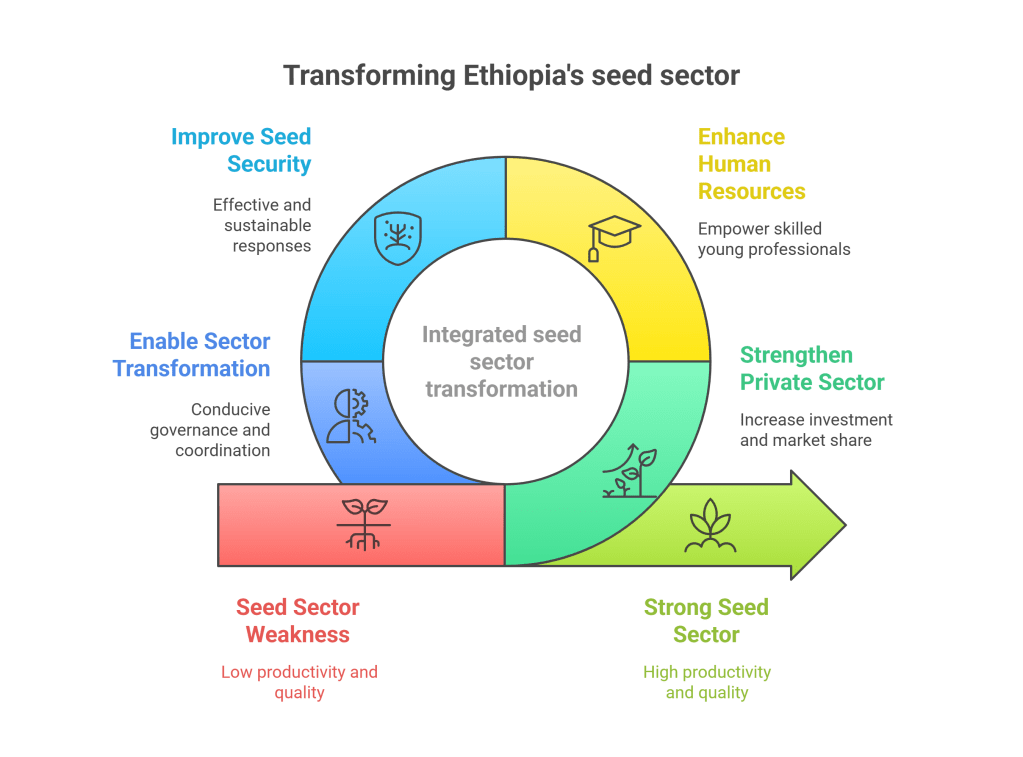
Based on the problem analysis and lessons learnt from ISSD Ethiopia and elsewhere presented in the introduction, we believe that four preconditions need to be met to raise the availability, access, stability, use, and crop and varietal portfolio of seed in Ethiopia and thereby its contribution to increasing crop productivity and quality for food security and nutrition, and both socio-economic and environmental outcomes. By no coincidence, these also correspond with the four primary outcomes targeted by the Partnership. The figure shares our theory of change in the integrated seed sector and food system framework, which illustrates our logic in a multi-level, integrated, and non-linear way.
First: Private sector strengthened in its contribution to seed delivery across the country. This requires a shift in the balance of power currently concentrated around four public seed enterprises and a few selected unions. Increasing private sector’s investment in and share of the market promises new innovations for farmers to improve their crops with.
Second: Human resources capacities in the seed sector are strengthened. A growing private sector and more competitive seed industry is going to need skilled young men and women empowered with the knowledge to take up technologies to innovate crop production and raise crop yields sustainably.
Third: Responses to seed insecurity are effective and sustainable. Ethiopia faces conflict and natural disasters on several fronts, which calls for effective humanitarian responses to seed insecurity that do not undermine farmer- and community-based systems and formal markets for certified seed. The country needs to rebuild its seed-related assets and strategic reserves of seed to recover from years of depletion.
Fourth: Transformation of the seed sector is enabled. Such developments need to be governed in a conducive way, which calls for effective systems and networks of coordination (also among the humanitarian, development, and peace communities); regulatory service provision; and investment in sector-strategic capital.
The synthesis of these four primary outcomes (putting them all together) is complementary. There are no tensions or trade-offs between them or their underlying activities and this is intentional in the design of the scope and approach of the Partnership. Obviously, there will be wider-reaching consequences of what we decide (not) to invest in that may accelerate or alter the path of Ethiopia’s seed sector transformation. But we align with all important policies and strategies that have conducted such an analysis of costs and benefits at meta-level (4. Institutional embedding).
The whole is also greater than the sum of its parts. Synergy is unlocked by the transformative approach of the Partnership in working on niche innovations in seed markets in conjunction with actively reconfiguring the seed governance regime while harnessing landscape pressures of major socio-economic and environmental drivers. To illustrate with an example, we incubate new seed business models and improve the quality of regulatory services provided to these models while skilling emerging professionals for employment in these business models and increasing the demand for these business models by promoting their products among farmers.


You must be logged in to post a comment.